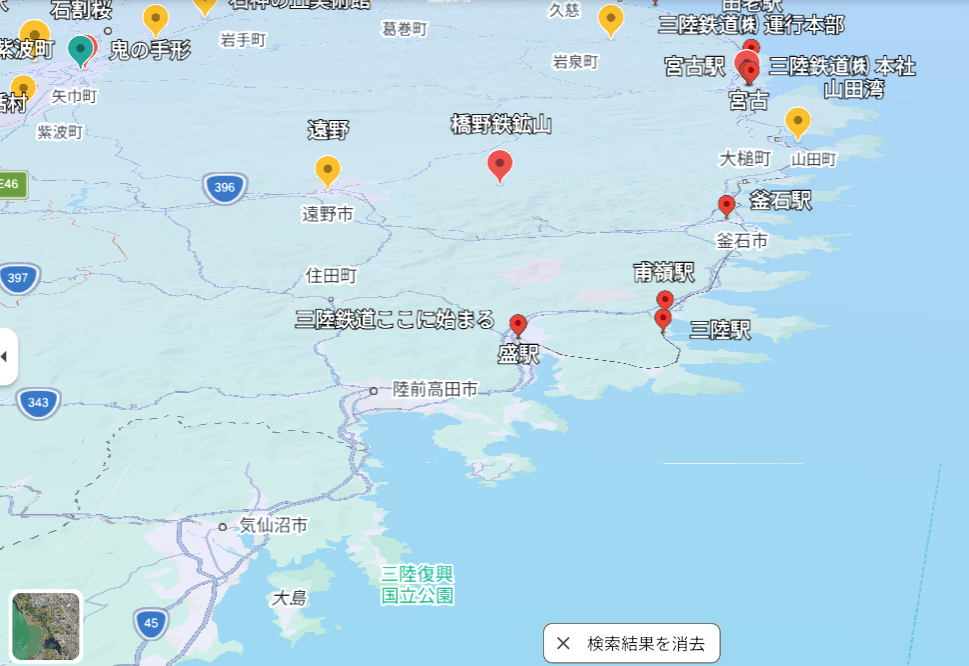
The Sanriku Railway offers breathtaking views of the sparkling Pacific Ocean and the rugged ria coastline. After witnessing the magnificent art of “erosion”—where relentless waves have sculpted the earth over eons—the iron road carries you west, inland toward Hanamaki.
In this land deeply loved by Kenji Miyazawa, gazing at the night sky invites you directly into the world of his masterpiece, Night on the Galactic Railroad. Countless stars, traveling across millennia, pile up in a luminous “accumulation” of ancient light, illuminating phantom rails that stretch across the heavens.
From the earthly memories carved by the ocean to the celestial memories woven by the stars. The terminal of the crashing waves is merely the departure station for the cosmos. Why not embark on this romantic, time-transcending railway journey—a poetic odyssey that can only be truly felt here in Iwate.
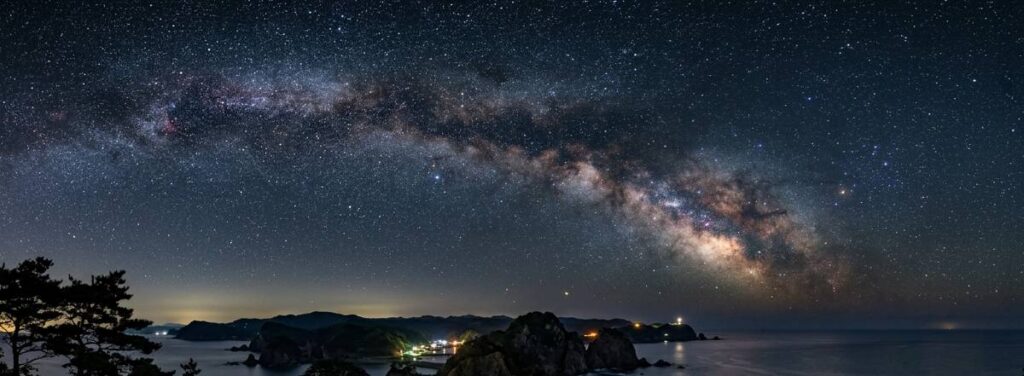
Kenji Miyazawa’s timeless masterpiece, *Night on the Galactic Railroad*, is often perceived by readers as a mere product of fantasy. However, when standing on the coastline of Hirono Town in Iwate, that perception is fundamentally overturned. In the darkness, the boundary between the sea and the sky dissolves, and the sight of the Milky Way arching from the horizon to the zenith is the very abyss of the cosmos that Kenji sought to depict. This is one of the few “sacred sites of the stars” in Japan, where literature and astronomy intersect.
The Sanriku Cliffs: An Invitation to Cosmic Immersion
The topography of the Sanriku Coast narrates the rugged history of our planet. The cliffs of Hirono are the “skin of the Earth,” layered with ancient strata, while the Pacific Ocean laps at its feet—sometimes silently, sometimes violently. Looking up at the night sky in this place, far removed from artificial light, is not merely astronomical observation. It is a rare experience where hundreds of millions of years of geological time and tens of thousands of light-years of astronomical time synchronize within one’s consciousness. Here, the stars do not just shine; they possess a gravity that captures the heart of the observer.
“True Happiness” in the Absence of Light Pollution
In modern society, we are constantly bathed in information and exposed to artificial light. However, the night sky of Hirono mercilessly strips away such excessive stimuli. In the absence of streetlights, human eyes regain their original sensitivity, coming to perceive the complex density of the Milky Way with the naked eye. Perhaps the “true happiness” that Kenji sought refers to these very moments—surrendering oneself to the movement of the cosmos in the silence, undisturbed by anyone. The act of looking up at the starry sky is a philosophical ritual: it is the recognition of one’s own smallness, and simultaneously, the reclamation of the sense of solidarity that comes from knowing we are a part of the universe.
The night sky of Hirono weaves a different story with each season: the constellations shining in the clear air of spring, the overwhelming density of the Milky Way in summer, the crisp, deepening stars of autumn, and the diamond-like brilliance floating in the frozen sky of winter. Visiting this place is not merely tourism; it is a journey to walk the corridor of the galaxy that Kenji once saw, using one’s own feet. Here in Iwate, we can become passengers on the “Galactic Railroad” ourselves, leaving behind the clamor of daily life to resonate with the profound depths of eternal time. In the silence of this sacred site of stars, we find our own “true happiness” etched into the boundless dark.